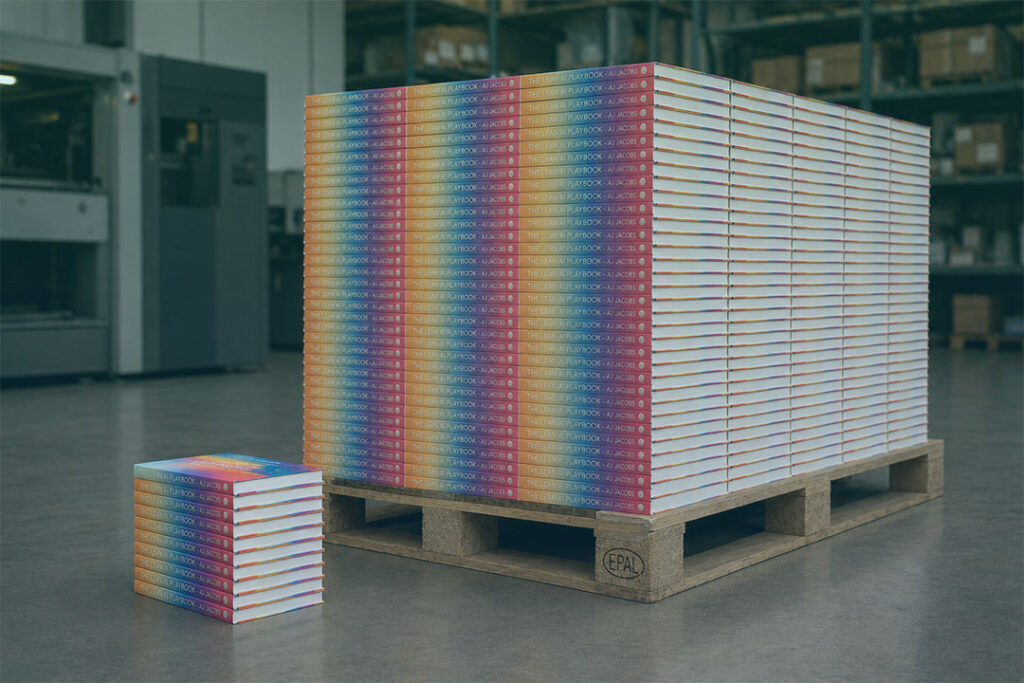
Print your book in Australia and one of the first decisions you’ll face is how many copies to order. It sounds simple. It isn’t.
Print too few and your cost per book is high. You run out quickly. You reorder under pressure and pay more again.
Print too many and you’ve got cash tied up in stock sitting in a warehouse.
Most people land somewhere in the middle. The right number depends on what you’re trying to do.
Let’s break it down properly.
Why Print Run Size Matters When You Print Your Book in Australia
The number of books you print affects everything.
Cost per unit
Cash flow
Storage
Distribution
Profit margin
Here’s a simple example.
Printing 250 books might cost $12 per unit.
Printing 2,500 books might bring that down to $4 or $5 per unit.
Same book. Same specs. Big difference in margin.
That’s why most commercial clients don’t think in terms of “how many do I need right now.” They think in terms of “what volume gives me the best return.”
If you’re selling, distributing, or using books as part of a business, volume matters.
For a deeper breakdown of how pricing scales, see this guide on: How bulk printing reduces cost per unit.
Small Runs vs Bulk Runs: What Actually Makes Sense?
You can print 50 books. You can print 20,000.
The question is not what’s possible. It’s what makes sense for your situation.
Small print runs
If you’re testing a concept or doing a one-off project, a small run can work.
Authors printing a first edition
Internal documents or short-term use
Proofing before a larger order
But you’ll pay for it. Unit costs are high. Margins are tight.
Bulk print runs
This is where things shift.
Bulk orders are where custom book printing starts to make financial sense.
Businesses printing training manuals
Publishers supplying retail or Amazon
Organisations distributing books nationwide
We regularly see clients ordering 5,000 to 20,000 copies at a time. Not because they need them all tomorrow, but because the economics work in their favour.
If you’re serious about distribution, bulk wins almost every time.
You can explore more about bulk book printing strategy.
How to Choose the Right Print Quantity
There’s no perfect number. But there is a logical way to get close.
Start with demand
How fast will the books move?
If you’re selling online and doing 500 units a month, printing 5,000 gives you a 10 month runway.
If you’re supplying a retailer or warehouse, they may want a large shipment upfront.
Look at real numbers. Not hopes.
Think about cash flow
Bulk printing lowers your cost per book. But it requires upfront spend.
Let’s say:
1,000 books at $7 each = $7,000
10,000 books at $3.50 each = $35,000
The second option is far better per unit. But it ties up more cash.
You need to balance margin with liquidity.
Factor in storage and logistics
Books take space. More than people expect.
If you’re printing thousands, you need a plan.
Some clients ship directly to fulfilment centres.
Others split deliveries across locations.
Some use warehouse storage, or might even have space at the office or home.
If you’re working with book printing services in Australia, this is something you can coordinate upfront. It’s not just about printing. It’s about where those books go next.
For more on distribution strategies, see: Printing Books in Australia for International Distribution
Plan for reorders
Reordering small batches sounds flexible. It’s not always efficient.
Every print run has setup costs. Plates, machines, labour.
Ordering 500 books ten times will cost more than ordering 5,000 once.
We see this mistake a lot. Businesses try to stay “safe” with small runs, then end up paying more over time.
Real-World Example: Bulk Done Right
One client prints 10,000 to 20,000 books per order. Each book is around 300 pages.
They don’t store them in one place. The finished books are shipped straight to a warehouse in Sydney for distribution.
They’re selling through Amazon and other channels. The print run isn’t based on demand and margin.
If they printed 500 at a time, the business wouldn’t work.
That’s the difference bulk makes.
When It Makes Sense to Print Your Book in Australia
There’s a reason many businesses choose to print your book in Australia rather than offshore.
Faster turnaround
More control over quality
Simpler logistics for local distribution
If your audience is in Australia, printing locally removes a lot of friction.
It also gives you flexibility. Need a second run? It’s easier to organise. Need to adjust specs? You’re not locked into long international lead times.
For businesses and publishers, that control is often worth more than chasing the absolute lowest unit price overseas.
You can also review Mint’s full bulk book printing to see available options.
For general publishing insights, see this overview from the Australian Government.
Custom Book Printing and Scaling Up
Custom book printing isn’t just about paper and binding. It’s about building something that fits your business model.
Hardcover or softcover
Retail-ready finishes
Shrink wrapping or barcoding
Packaging for distribution
These decisions tie directly into your print run.
If you’re deciding between formats, this guide helps: Hardware vsPaperback Softcover.
If you’re going to invest in premium finishes, it makes more sense to spread that cost across a larger quantity.
That’s why most commercial jobs lean toward bulk.
Getting the Balance Right
There’s no magic number. But there is a pattern.
Small runs are for testing.
Medium runs are for cautious growth.
Large runs are for businesses that know their numbers.
If you’re planning to sell, distribute, or scale, you’ll almost always end up moving toward higher volumes.
The key is timing it properly.
Talk It Through Before You Print
If you’re planning to print your book in Australia, don’t lock in a quantity too early.
Run through your numbers. Look at demand. Look at your margins.
Then speak to someone who deals with this every day.
At Mint Printing, we help businesses work out the right print run based on how they actually plan to use the books. Not just what sounds safe on paper.If you’re unsure whether to print 500 or 5,000, get in touch here.