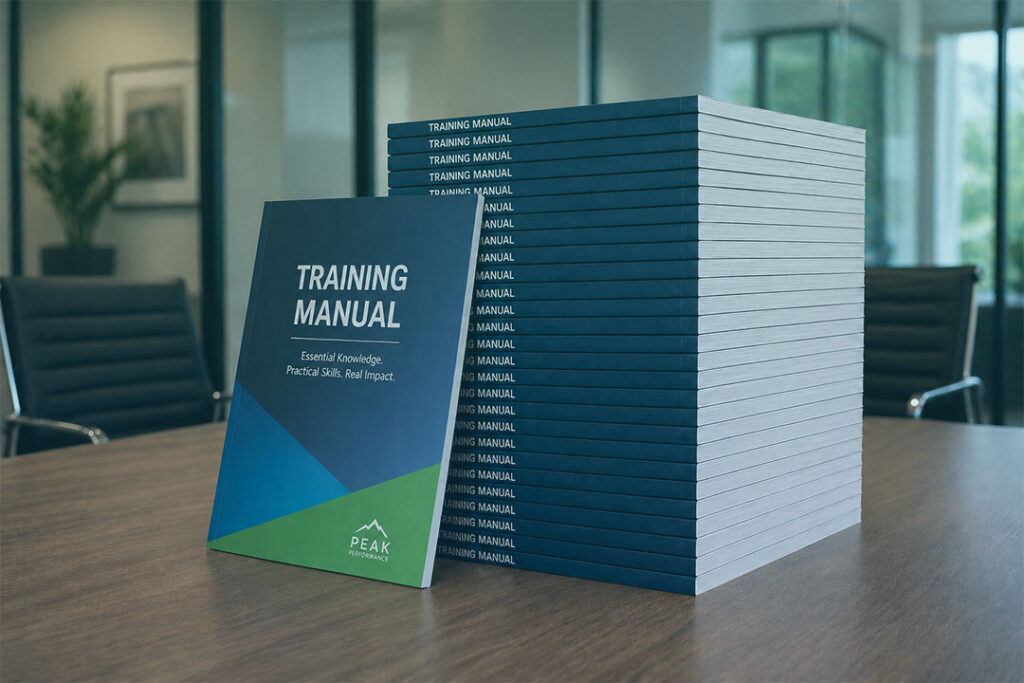
Commercial book printing is what businesses turn to when small print jobs stop making sense. You might start with 100 manuals. Then it becomes 500. Before long, you are ordering thousands at a time and the cracks start to show.
Different suppliers give different results. Colours shift. Bindings fail. Deadlines slip.
That is usually the point where businesses move away from basic online printers and look for something built for scale.
Why businesses rely on commercial book printing
Training manuals and corporate publications are ongoing work. They are not one off jobs you print once and forget.
A national company onboarding staff across five states might need 3,000 manuals delivered across multiple sites in the same week. A training provider might update course material every quarter and reprint 2,000 copies each time. A corporate team might need annual reports, product guides, and internal handbooks printed in bulk.
These are commercial book runs. The expectations are different.
You need every copy to match. Same colour. Same finish. Same feel. If one batch looks different from the next, it reflects on your brand.
And timing matters. If your manuals are not ready when training starts, everything stalls.
What makes training manuals different from standard books
Training manuals get used hard. They are opened all day, written on, carried between sites, and thrown in bags.
We see it all the time. Manuals printed on thin stock start curling within a few weeks. Glued spines crack after a handful of training sessions. Pages fall out halfway through a course.
That is why material choices matter.
If your manual runs over 100 pages, you are usually looking at perfect binding or section sewn binding. Paper weight needs to be thick enough to handle notes without bleeding through. Covers often need a protective finish so they do not scuff after a few days of use.
Corporate publications are different again. A product catalogue needs clean colour across every page. A company report needs to feel solid in hand. These are the details people notice straight away.
This is where large quantity book printing needs to be planned properly. Once you are printing thousands of copies, mistakes are expensive. You can also review how bulk book printing reduces cost per unit to better understand the financial side.
Planning commercial book runs properly
Most issues do not happen in the press. They start with the files.
We regularly receive artwork with no bleed, low resolution images, or incorrect colour settings. That slows everything down. Sometimes it leads to reprints.
If you are printing 10,000 manuals and the file setup is wrong, you are not losing a few hundred dollars. You are risking the entire job.
A proper commercial book printing process includes a full file check before anything goes to print. Page order is reviewed. Colours are checked. A digital proof is sent so you can confirm everything looks right.
For example, if a training organisation is rolling out new material nationally, they cannot afford to discover an error after delivery. It needs to be picked up before production starts. If you are unsure about file setup, you can also check the frequently asked questions for guidance.
Scaling up with large quantity book printing
The cost per book drops as volume increases. That is the simple part.
Printing 200 copies might cost significantly more per unit than printing 2,000. At 5,000 or 10,000 copies, the savings become noticeable.
This is why businesses move to commercial book runs once demand is steady. Instead of placing small orders every few weeks, they plan larger runs and reduce cost while keeping quality consistent.
One client might order 500 manuals at a time and pay a high unit price. Shift that to 5,000 units and the cost per book drops, while every copy matches exactly.
It also makes logistics easier. One production run. One standard. No variation between batches. For a deeper breakdown, see the complete guide to bulk book printing in Australia.
National distribution without the usual issues
Printing is only part of the job. Getting the books where they need to go is just as important.
You might need stock sent to offices in Melbourne, Sydney, and Brisbane at the same time. Or delivered straight to a warehouse for fulfilment. Some businesses ship directly to Amazon distribution centres.
At that point, you are not just printing books. You are coordinating production, packing, and delivery across multiple locations.
If timing slips, everything downstream is affected. Training schedules. Product launches. Internal rollouts.
That is why most businesses prefer one supplier who handles the entire process rather than juggling multiple vendors. Mint also supports businesses printing for global markets, as explained in printing books in Australia for international distribution.
For broader context on print production standards, you can refer to the Australian Government’s guide to editing and proofreading practices.
Choosing the right commercial book printing partner
Not every printer is set up for this type of work.
Many focus on small orders. Business cards, flyers, quick turnaround jobs. That is fine for those products. It does not translate well to large quantity book printing.
For commercial work, you need a supplier who deals with volume regularly. Someone who understands how to manage large print runs, tight deadlines, and detailed specifications. You can learn more about how Mint operates on our difference page.
You also want clear communication. You should know where your job is without chasing updates. If something needs to be fixed, it should be picked up early.
That is what separates a smooth job from a stressful one.
Commercial book printing done properly
If you are planning your next batch of training manuals or corporate publications, the goal is simple. Get it right the first time. Print at scale. Deliver without issues.
Mint Printing Australia handles commercial book printing for businesses that need consistency across large runs. Whether you are printing 250 manuals or 20,000 corporate publications, the process is built around getting it done properly from the start.
Send through your specs, or even a rough idea of what you need, via the get a quote page. We will review your files, talk through the best options, and map out the most cost-effective way to print and deliver your books.